
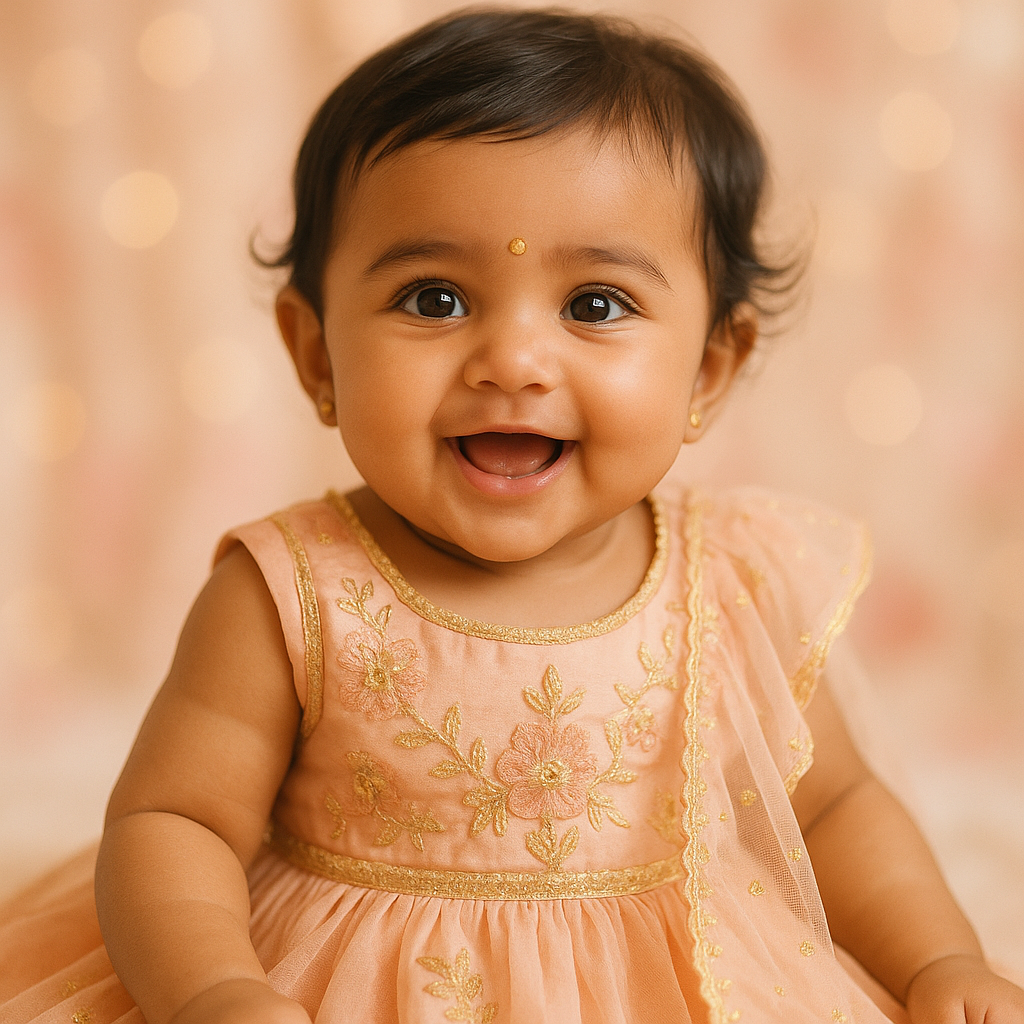
A little hand pulls it aside. Someone peeks out to ask if the dupatta is necessary. Another child is already walking around in one shoe because the other has disappeared under a pile of clothes.
Whenever I see that scene, I remember a wedding from a few years ago.
My niece had arrived looking absolutely lovely in a tiny lehenga. Her hair was neatly braided, the bangles matched perfectly, and every adult commented on how beautiful she looked. She smiled politely through all of it.
Ten minutes later, she was on the floor with her cousins, making a tower out of bangles and bottle caps.
The skirt kept bunching around her knees. The blouse tugged at the shoulders each time she reached forward. Every few minutes someone said, “Sit properly,” and every few minutes she forgot.
Not because she was naughty. Because she was five.
The floor test
Now, whenever I shop for ethnic wear for little girls, I find myself watching what happens when the child sits down.
Not on a chair.
On the floor, where children actually spend most family functions.
They sit cross-legged during poojas, lean sideways while listening to stories, and sprawl out beside cousins once the formal part is over. I’ve noticed that some outfits look perfect standing still and immediately become awkward the moment a child folds her legs.
The waistband suddenly matters more than the embroidery.
And I think many parents have had that quiet realization in a crowded wedding hall

Arms in the air
The next thing I notice is what happens when she forgets she’s being observed.
A relative arrives and she throws both arms up in excitement. Someone offers a sweet. She reaches for it without thinking. A grandparent bends down for a hug.
Children spend celebrations stretching, waving, reaching, and climbing into laps. An outfit that only works when the child stands straight with her hands by her side feels less like clothing and more like a costume.
I don’t say that aloud while shopping.
I just keep watching
The moment that tells the truth
And then comes the part no child needs instructions for.
The twirl.
It usually happens near a mirror, often before any adult has asked.
Sometimes she turns once and stops to look at herself. Sometimes she keeps spinning until the skirt lifts slightly and she bursts into laughter. That second kind of twirl tells me more than any size chart ever could.
The best fit ethnic wear for kids seems to invite movement rather than ask permission for it.
What the mirror doesn’t show
I used to ask, “Does it look festive enough?”
Now I find myself wondering, “Will she still be comfortable after dinner?”
Because the real test of a festive outfit happens hours later. When the hair clips are slipping out. When there is a tiny stain from a sweet nobody noticed. When she is sleepy in the car with her head on someone’s shoulder and one sandal missing.
Those are the moments that become family memories.
Not the five seconds in front of the mirror.
Children usually decide first
One thing I’ve learned is that children are surprisingly honest about clothes.
They don’t care whether a lehenga is handcrafted or trending. They care whether they can breathe, bend, run, sit, and spin. If they keep adjusting the outfit, that is information. If they forget they’re wearing it, that is information too.
Whenever parents ask me how to choose ethnic wear for girls, I think of that wedding floor covered in bangles and bottle caps.
A good festive outfit doesn’t ask a child to stop being herself.
It lets her remain the child who sits on the floor, raises her arms when she sees someone she loves, and twirls before anyone tells her to.
That is still the dress test I trust most.

